

Air Canada or Air France Business from Montréal to Paris? Seats, meals and a short night
On a short eastbound flight, an expensive flat bed is only useful for the time you actually spend in it.
Flight reviews27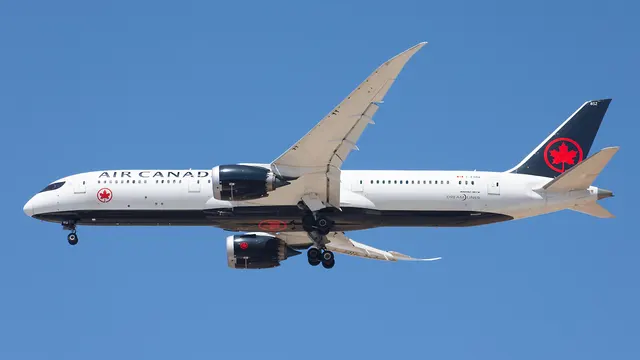
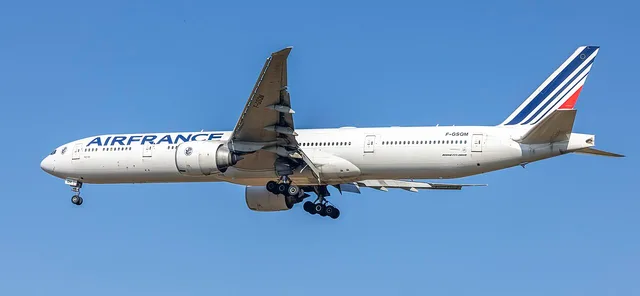
For sleep on Montréal–Paris, the meal plan and pre-departure routine can matter more than the cabin label. Air Canada publishes an express light-meal option; Air France needs a closer look at the seat configuration on your flight. And Air Canada’s Signature Suite experience in Toronto is not what a Montréal departure provides.
01A like-for-like YUL–CDG decision
The comparison is a nonstop Montréal–Paris CDG Business round trip for two adults, with product information checked on 8 November 2026. Toronto connections and Paris Orly arrivals are different itineraries. For Canadian travellers, totals should be in CAD and should include the same baggage, seat and ticket-flexibility requirements.
The photographs come from separate flights: Air Canada westbound in a report published in 2023, and Air France eastbound in a report published in 2026. They document real seat layouts, not a controlled comparison of meal timing or sleep. Neither establishes the aircraft assigned to your future booking.
| Question | Air Canada | Air France |
|---|---|---|
| Which seat? | Confirm Signature Class and the assigned layout | Distinguish the 14-seat 777 cabin from newer door-equipped seats |
| How to eat quickly? | Published Express Light Meal option | Discuss dinner and breakfast preferences with the crew |
| Which Montréal lounge? | International Maple Leaf Lounge | Eligibility depends on the ticket and any qualifying status |
| Common mistake | Expecting a Toronto-style Signature Suite at YUL | Assuming every Business fare includes identical airport benefits |
02The aircraft name does not identify the Air France seat
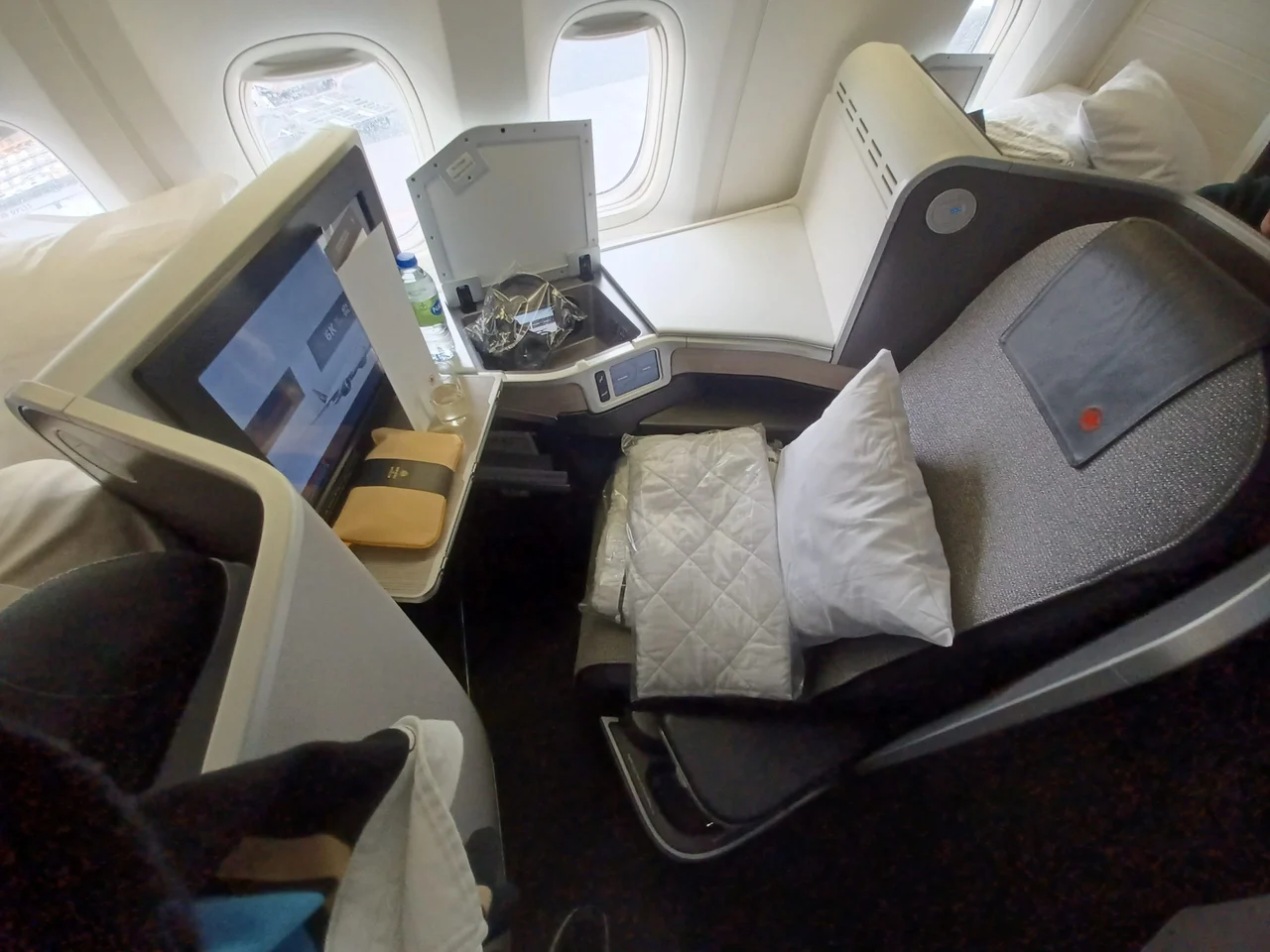
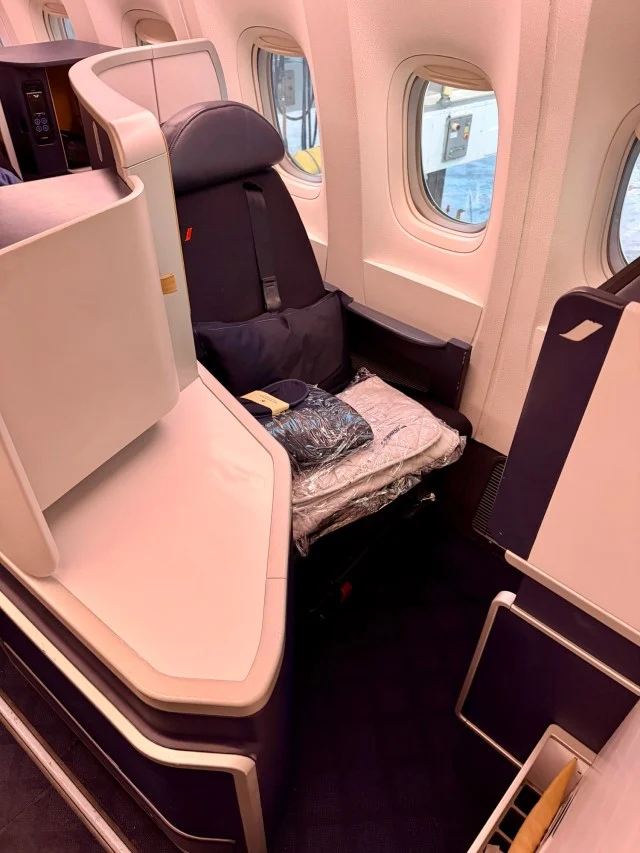
The Air Canada photograph shows a reverse-herringbone window seat with a console between the passenger and the aisle. Air France’s 14-seat layout alternates the relationship between the window seat and the aisle. The photographed window-adjacent position has a substantial shell separating it from passing traffic; an aisle-adjacent row is a different proposition.
Air France’s original 2020 specification for this cabin describes 1-2-1 seating, a bed nearly two metres long and mirror-front storage. That release identifies the product, not its current assignment to every Montréal flight. It should not be confused with the airline’s newer closing-door suite.
If the actual seat map shows this small cabin and the positions you want are available, it can be an appealing choice. If only the more exposed seats remain, paying extra simply for a fourteen-seat cabin is harder to justify. A couple who wants to talk may prefer the centre pair; two people prioritising sleep may choose their preferred individual positions instead.
03Open surfaces and enclosed storage beside the seat
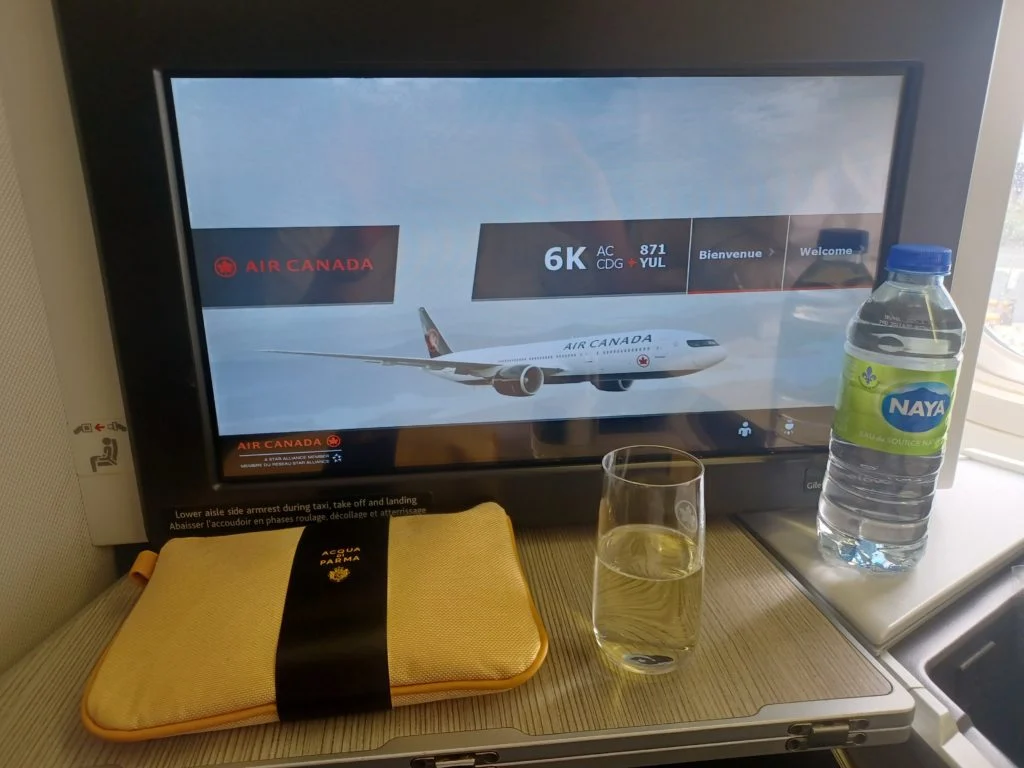
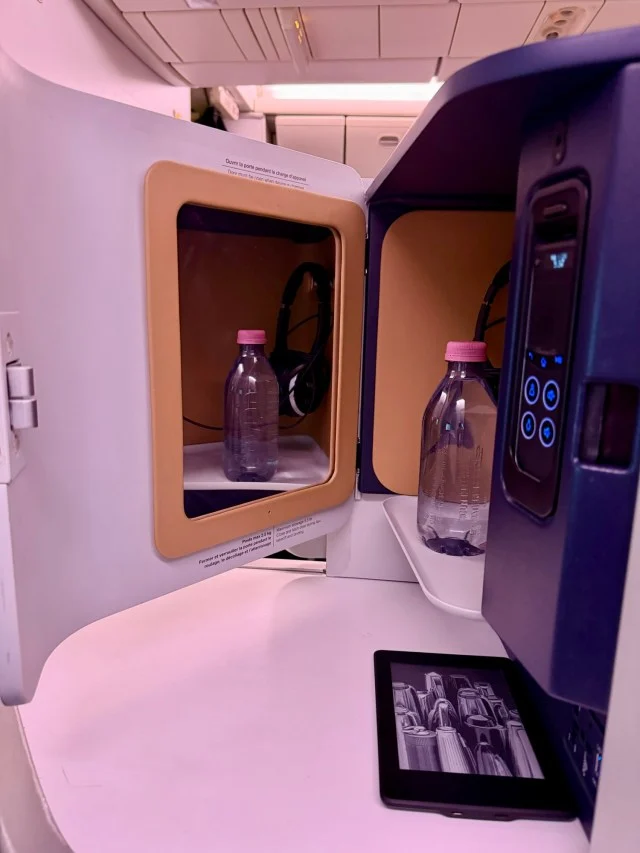
For a quick transition to sleep, think about where your glasses, cable and laptop go when dinner ends. Storage count alone is not very informative. Both photographs show space used for drinks and personal items; the Air France view also shows an enclosed compartment. Neither is a measurement of usable capacity. Check whether your own laptop and other essentials can be stowed within reach, without leaving them on a surface needed for dining. Follow the crew’s instructions about which spaces can be used during take-off and landing.
A short overnight flight is also a poor place to promise yourself a full work session, a leisurely dinner and a long sleep. Finishing the necessary work before boarding may do more for the following morning than choosing the larger screen.
04Air Canada’s express option is a lighter meal
The published Express Light Meal consists of an appetizer, bread, greens, cheese and crackers, and fruit served shortly after departure. It is not the full hot-main-course dinner simply delivered faster. Air Canada separately describes Dine on Demand for passengers who want a main course at a different time.
In the Air France flight report, the author declines dinner and asks to be woken for breakfast. That is one traveller’s experience, not a guaranteed schedule or promised amount of sleep. It illustrates a choice worth discussing when you board: eating every course is optional.
| Time before lying down | Maximum lying-down window | Trade-off |
|---|---|---|
| 90 minutes for dinner and preparation | 3 hours 45 minutes | More time dining; less time resting |
| 45 minutes for a light meal and preparation | 4 hours 30 minutes | 45 minutes more than the first scenario |
| 30 minutes, with no meal | 4 hours 45 minutes | Requires a sensible pre-flight food plan |
This is a time budget, not a prediction of sleep. Announcements, turbulence and the time it takes to fall asleep reduce it further. The westbound return has different daylight and flight-time considerations; it may be the better direction for enjoying the longer meal.
05Signature Class does not mean a Signature Suite at Montréal
| Airport | Facility to assess |
|---|---|
| Montréal YUL | International Maple Leaf Lounge |
| Toronto YYZ / Vancouver YVR | Signature Suite for eligible passengers; not available at YUL |
Air Canada’s Signature Suites are at Toronto and Vancouver. At YUL, the relevant facility is the International Maple Leaf Lounge; its advertised live cooking station operates at selected times. Photos of Toronto’s à la carte experience are therefore the wrong basis for valuing a Montréal departure.
For Air France, the booking’s lounge inclusion and your own status are what matter. If a lower fare does not include access, do not assume that a paid visit can always be added at the airport. Eligibility, opening hours and capacity are separate questions. Leave time for a terminal meal if your plan depends on eating before boarding.
This is also why an existing lounge entitlement changes the fare comparison. A passenger already entitled through status should not pay twice in their mental calculation for the same access. Someone arriving too late to eat may get little value from an included lounge, however impressive the pictures look.
06The fare difference after the extras you will actually use
| Extras purchased | Extra cost | Remaining AF saving |
|---|---|---|
| None / already entitled | C$0 | C$300 |
| Two travellers at YUL only | C$140 | C$160 |
For a February 2027 round trip, compare identical travel dates, passenger counts and change/refund requirements. Matched live fares were not obtained. The following is a hypothetical CAD calculation, not a fare quotation or observed lounge price: if Air France is C$300 less for the two tickets combined, and required extras cost C$70 each for the two travellers at YUL only, the remaining saving is C$160.
That arithmetic is useful only if the extra can actually be purchased and used at the required time. Do not add a benefit’s advertised value to the more expensive fare if you would never buy or use it. Include taxes and carrier charges, and distinguish a cash refund from a credit and a waived change fee from a fare difference.
Air Canada is a sensible candidate when its express meal and Montréal lounge fit a plan to get to bed early. Air France is compelling when the assigned seat you want is available and the total, including any needed airport benefits, works for you. Start with a departure and arrival that suit the following day; then decide how much the remaining seat and service differences are worth.
Air Canada 777: the Paris–Montréal flight report
Air France 14-seat 777: the Montréal–Paris flight report
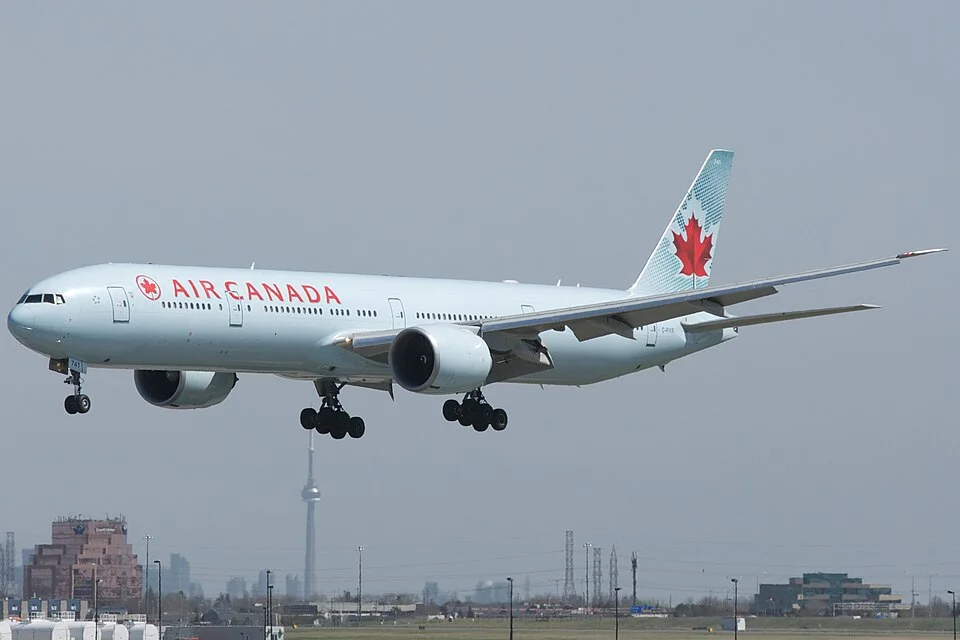 13 flight reviewsAir Canada Business flight reportsBrowse reviews
 AI editorial illustration14 flight reviewsAir France Business flight reportsBrowse reviews
Related flight reviews
 Air Canada
London Calgary
Boeing 787-9 · Business
Air Canada 787 Business Class Review: LHR to YYC (2026)
This Life in TripsRead review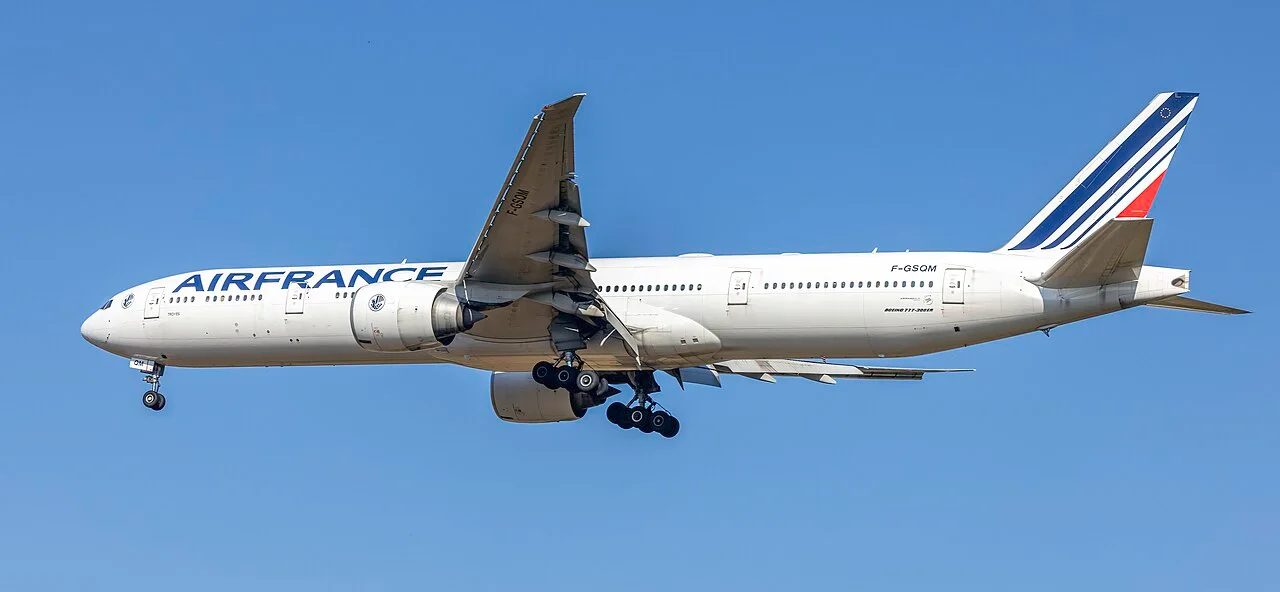 Air France
Montreal Paris
Boeing 777-300ER · Business
Air France, Business Class – Boeing B 777-300: Montreal to Paris CDG
knightofmaltaRead review Air France
Paris Johannesburg
Boeing 777-300ER · Business