
Aeroplan stopover or two awards? Compare points, fees and flexibility
Two nights in Tokyo can fit inside a longer trip. The useful comparison is the whole ticket, not just the stopover surcharge.
Flight reviews4
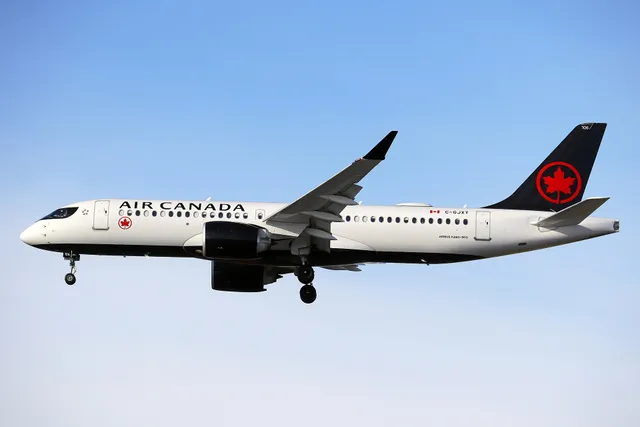
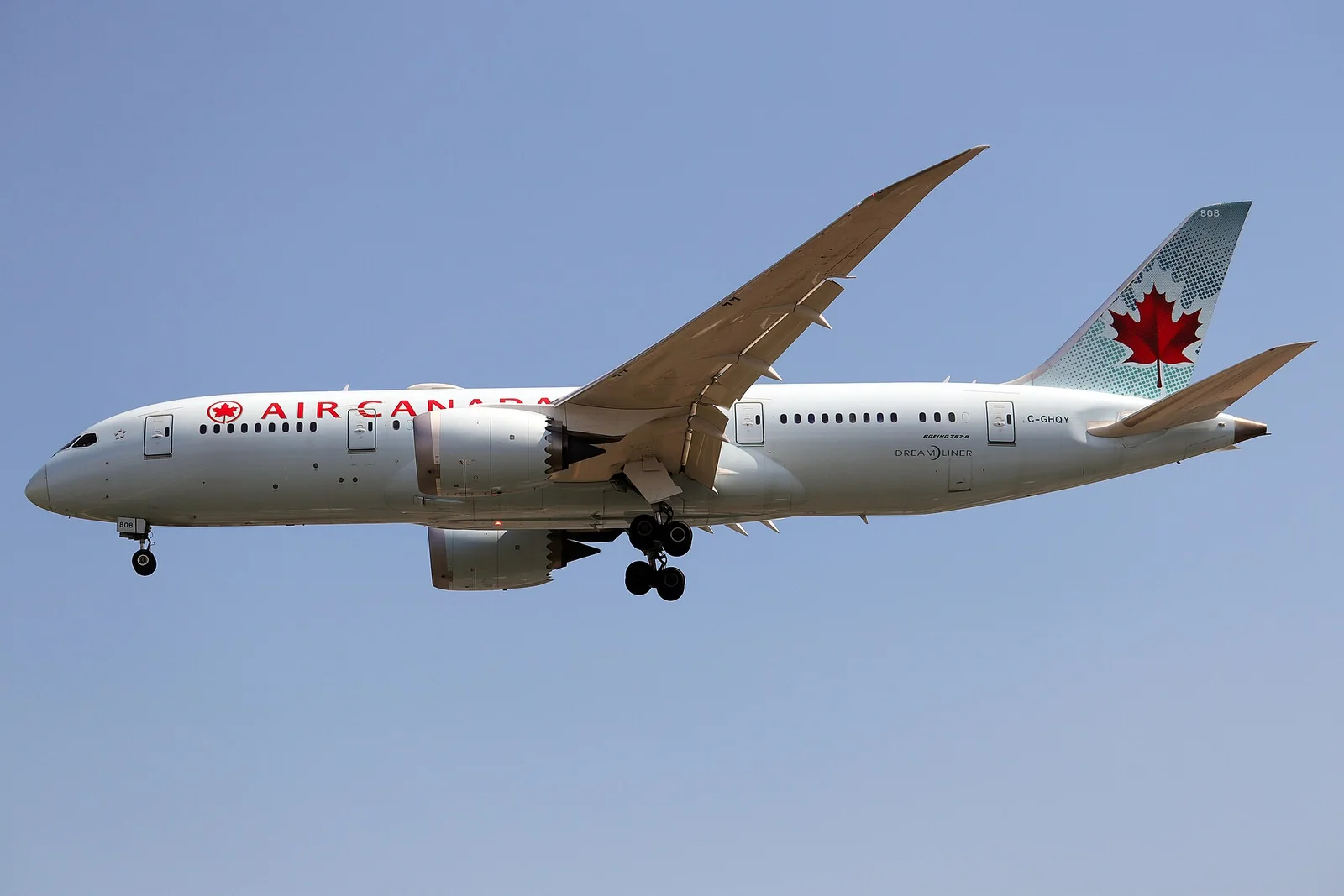

A stopover can add a second destination for 5,000 points, but routing, total pricing and cabin availability still matter. Separate awards buy different flexibility—and can mean another partner booking fee.
01Price three versions of the same holiday.

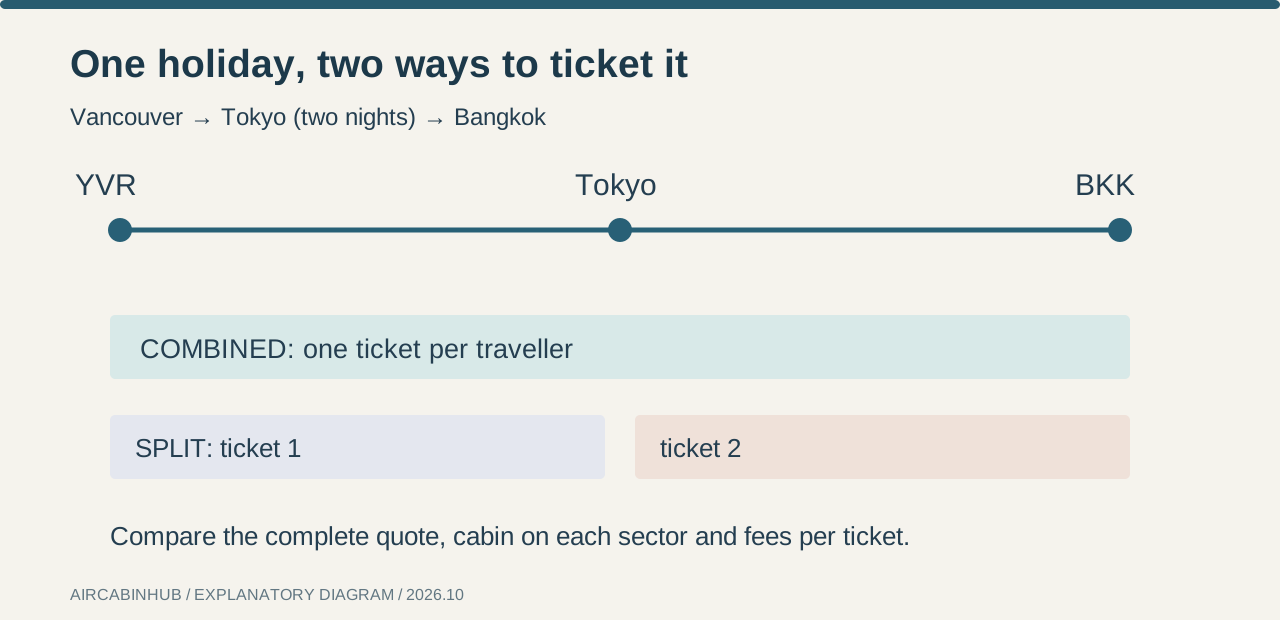
Read the diagram as text
- Stopover award
- Complete route + permitted stop
- Separate awards
- Each ticket has its own price and rules
- Compare
- Same dates, people and cabin by sector
For a Canadian traveller combining Japan and Thailand, an Aeroplan stopover is worth testing before booking two awards. Start with Vancouver–Tokyo–Bangkok, then add two nights in Tokyo using a multi-city search. Compare that result with separate Vancouver–Tokyo and Tokyo–Bangkok awards. This is an itinerary to investigate, not a claim that award seats are currently available.
| Check | One award with a stopover | Two separate awards |
|---|---|---|
| Points | Full journey quote plus stopover pricing | Sum of both independent quotes |
| Partner booking fee | C$39 per ticket containing partner flights | C$39 on each ticket containing partner flights |
| Flexibility | One ticket with one set of conditions | Each ticket can have different conditions |
| Cabins | Check every segment | Check each ticket individually |
A stopover costs an additional 5,000 points, but that is not a guarantee that any route will price as your original award plus 5,000. Routing and the complete journey determine the quote. Keep the dates, passengers and cabin identical across your comparisons; otherwise, you may be measuring a different trip.
02The stop must fit the rules before it fits the budget.

Read the diagram as text
- Origin → stop
- The first eligible sector
- Stopover
- Check permitted location and duration
- Stop → destination
- Onward sector and total routing rules
Aeroplan permits one stopover per direction, lasting no more than 45 days, on eligible itineraries. Its detailed policy excludes stopovers in Canada, the United States and China. A two-night Tokyo visit can therefore be a useful candidate; a two-night Toronto visit is not the same type of eligible stopover.
You cannot assume every detour will be accepted. The routing must meet the programme’s rules, and an open jaw at the stopover is not permitted. Arriving in one city and leaving another can turn an appealing map into a different ticketing problem. Use the multi-city quote to validate the itinerary before transferring points or committing to hotels.
03Search the long flight first, then rebuild the whole journey.
For Vancouver–Tokyo–Bangkok, begin with the long Pacific crossing on the date you can travel. Search for the actual number of passengers and inspect the cabin on that sector. Then search Tokyo–Bangkok after the two-night visit. This helps you see which part of the trip is constraining your choices before you try to assemble it.
Next, run the multi-city search for the complete itinerary and record its final points and cash total. Finding each sector separately is useful research; it is not confirmation that Aeroplan will combine those exact flights at the sum you expect. The through quote remains the decision price. Avoid moving points solely because the first sector looked promising.
| Record | Why it changes the decision |
|---|---|
| Operating airline and cabin on each flight | A business label can conceal economy on the long sector |
| Tokyo arrival and onward departure dates | The stop should provide usable time in the city |
| Total points and total C$ payment | Compare the checkout total, not just the stopover increment |
| Ticket count and fare option | These determine which change and cancellation costs need to be added |
A two-night visit is also different from a long airport connection. It adds hotel nights, transport and time in Japan. If you wanted Tokyo anyway, those are part of the holiday; if you only added it to obtain a supposedly cheap redemption, they can overwhelm the points saving. Choose the trip first, then use the stopover rule to price it.
04Compare the points saving and the cash saving separately.
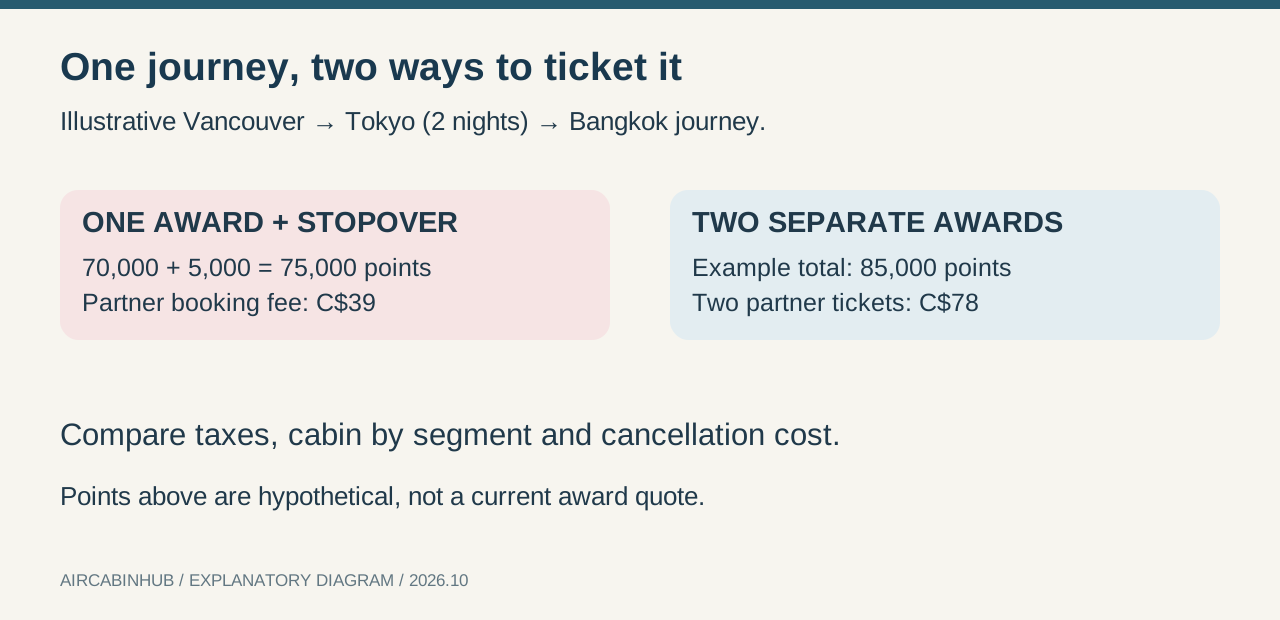
Suppose the through journey costs 70,000 points, and adding the stop produces a 75,000-point quote. Suppose two separate awards total 85,000. The combined ticket saves 10,000 points in this hypothetical example. If both separate tickets include partner airlines, their partner booking fees total C$78, versus C$39 on the combined ticket. Taxes and other cash charges still need to be compared.
If the split version costs fewer points, that can outweigh its extra booking fee. Rather than assigning every Aeroplan point a universal value, ask what you would actually pay to keep the difference. Also compare the cash fare you would genuinely buy; an expensive flexible fare you would never purchase can exaggerate the apparent saving.
The break-even calculation can work in the other direction. Imagine splitting saves 8,000 points but adds C$120 to the complete cash total. You are paying 1.5 Canadian cents to retain each point. That can be reasonable if you have a realistic use worth more to you; it is less attractive if it creates an unwanted connection or a cabin downgrade. Keep this personal trade-off separate from a universal valuation of Aeroplan points.
05A cheap total can conceal the wrong cabin or an awkward exit.

Read the diagram as text
- Short sector
- Business
- Overnight sector
- Check it has the cabin you need
- Pricing
- Highest cabin can set the direction’s price
Aeroplan prices mixed-cabin awards according to the highest cabin in each direction. That makes the segment list essential: business on a short flight does not turn the overnight flight into a bed. Do not accept the headline cabin label without checking which sector receives it.
For Business Lowest rewards, the published online change fee is C$75 per direction per ticket, while cancellation is C$150 per ticket; taxes may apply. Business Flexible has different fee treatment. With separate awards, changing one portion can be easier to isolate, but cancelling the whole holiday can involve fees on both tickets. Compare the actual fare options before deciding.
The stopover is strongest when the routing works, both important flights have suitable seats and the full quote beats splitting. Separate tickets remain worth checking when dates or cabins differ. Finish with a four-line record: points, cash, cabin by segment and cancellation cost. That is more useful than celebrating the 5,000-point headline alone.
06For two people, count tickets before multiplying fees.

Read the diagram as text
- One ticket each
- 2 × C$39 partner fee = C$78
- Two tickets each
- 4 × C$39 partner fee = C$156
- Difference
- C$78 before other taxes and charges
A booking reference and a passenger ticket are not interchangeable. Two people on one reservation still have individual tickets. In the example where both sectors use partners, a combined itinerary for two people carries C$78 in partner booking fees; splitting into two tickets per person makes that C$156. The saving is C$78 across the couple, before comparing all other taxes and charges.
| Item | Combined: 2 tickets | Split: 4 tickets |
|---|---|---|
| Partner booking fees, if every ticket contains a partner flight | 2 × C$39 = C$78 | 4 × C$39 = C$156 |
| Online cancellation on Business Lowest, outside any free-cancellation allowance | 2 × C$150 = C$300 | 4 × C$150 = C$600 |
The cancellation row assumes the entire unused trip is cancelled and all tickets use Business Lowest, with no status waiver; applicable taxes are extra. It does not mean that every change to a split journey costs twice as much. If you alter only Tokyo–Bangkok, you are dealing with those tickets, not automatically cancelling Vancouver–Tokyo too. That isolation can be the main reason to split when one part of the trip is still uncertain.
Compare a Flexible quote as a third option when the dates are unsettled. You need not assign a precise probability to cancelling: ask whether you would willingly spend the extra points today to remove the relevant cancellation charge. This makes the flexibility purchase visible instead of hiding it inside a larger points total.
Related flight reviews
 Air Canada
London Calgary
Boeing 787-9 · Business
Air Canada 787 Business Class Review: LHR to YYC (2026)
This Life in TripsRead review Air Canada
Montreal Los Angeles
Airbus A220 · Business
Review: Air Canada A220 Business Class
Live and Let’s FlyRead review Air Canada
Toronto Los Angeles
Boeing 787-9 · Business