
Air New Zealand Skycouch vs Premium Economy: one shared couch or better seats?
Skycouch changes how you use an Economy row. Premium Economy improves each person’s seat. The better choice depends as much on who shares the space as on the price.
Flight reviews3

A parent and small child, or a solo traveller comfortable curling up, may get more from Skycouch. Two adults who want their own space are often better matched to Premium Economy. A Skycouch is a shared surface, not two Business beds.
01The Skycouch surface is shorter than most adults
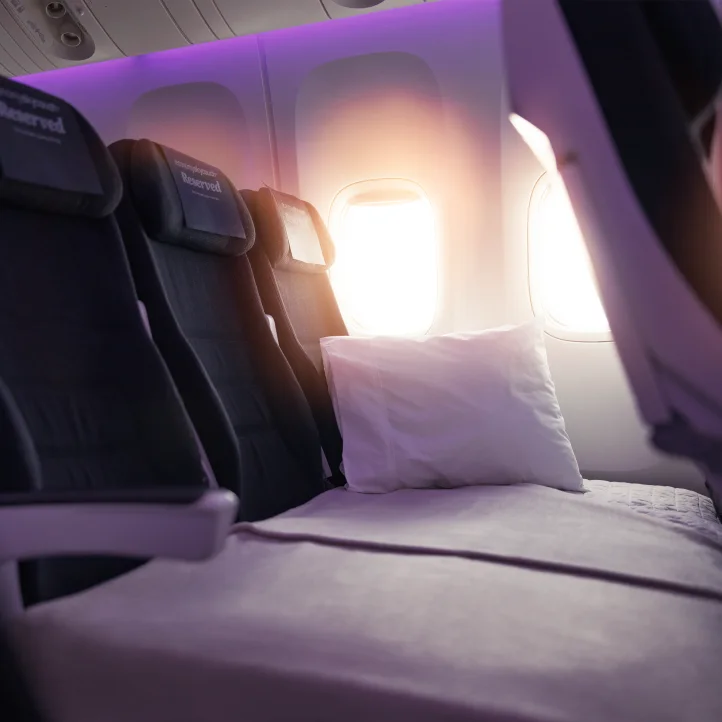
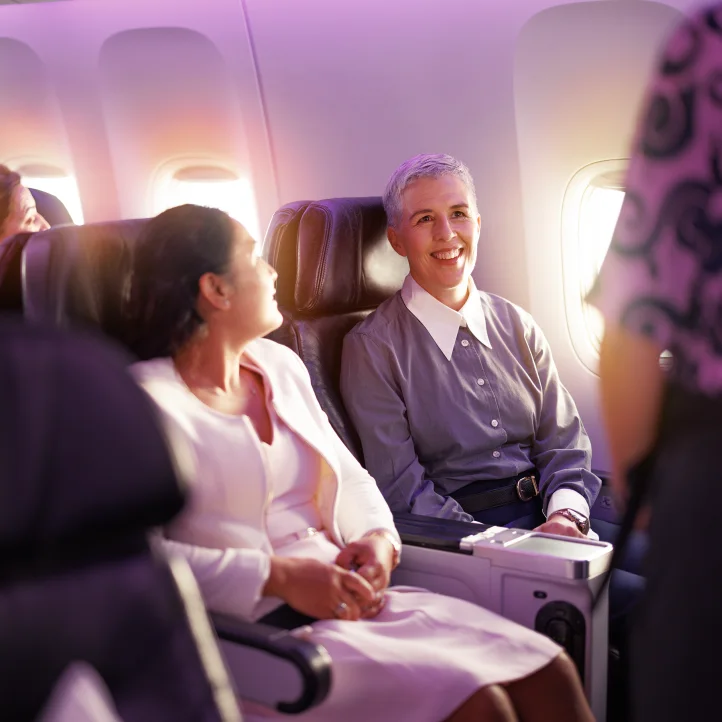
Skycouch raises the legrests across a row of three Economy seats. Air New Zealand gives the surface as 1.55m long and 74cm deep—approximately 5ft 1in by 29in. An adult taller than that cannot expect to stretch out straight across it. Curling up, bending the knees or changing position is part of the proposition.
Premium Economy offers a larger individual reclining seat. It is not a flat bed either, but the space allocated to you remains yours when your companion changes position. This is why “a couch versus a seat” is too simple a description of the choice.
| Question | Skycouch | Premium Economy |
|---|---|---|
| What do you buy? | Exclusive use of a configured Economy row | A higher-cabin seat for each passenger |
| How is extra space shared? | Across the group using the row | Each person has an individual seat |
| Can a tall adult lie straight? | The published length is only 1.55m | The seat reclines; it is not a bed |
| Meal and service level | Economy service | Premium Economy service |
| How should prices be compared? | Total Economy fares plus row supplement | Total Premium Economy fares |
An empty Economy row is not automatically a Skycouch. The fitted legrests, bedding and approved restraint arrangement are part of the product. Hoping for an empty row is a different, uncertain strategy.
02The same row feels different with one adult or two
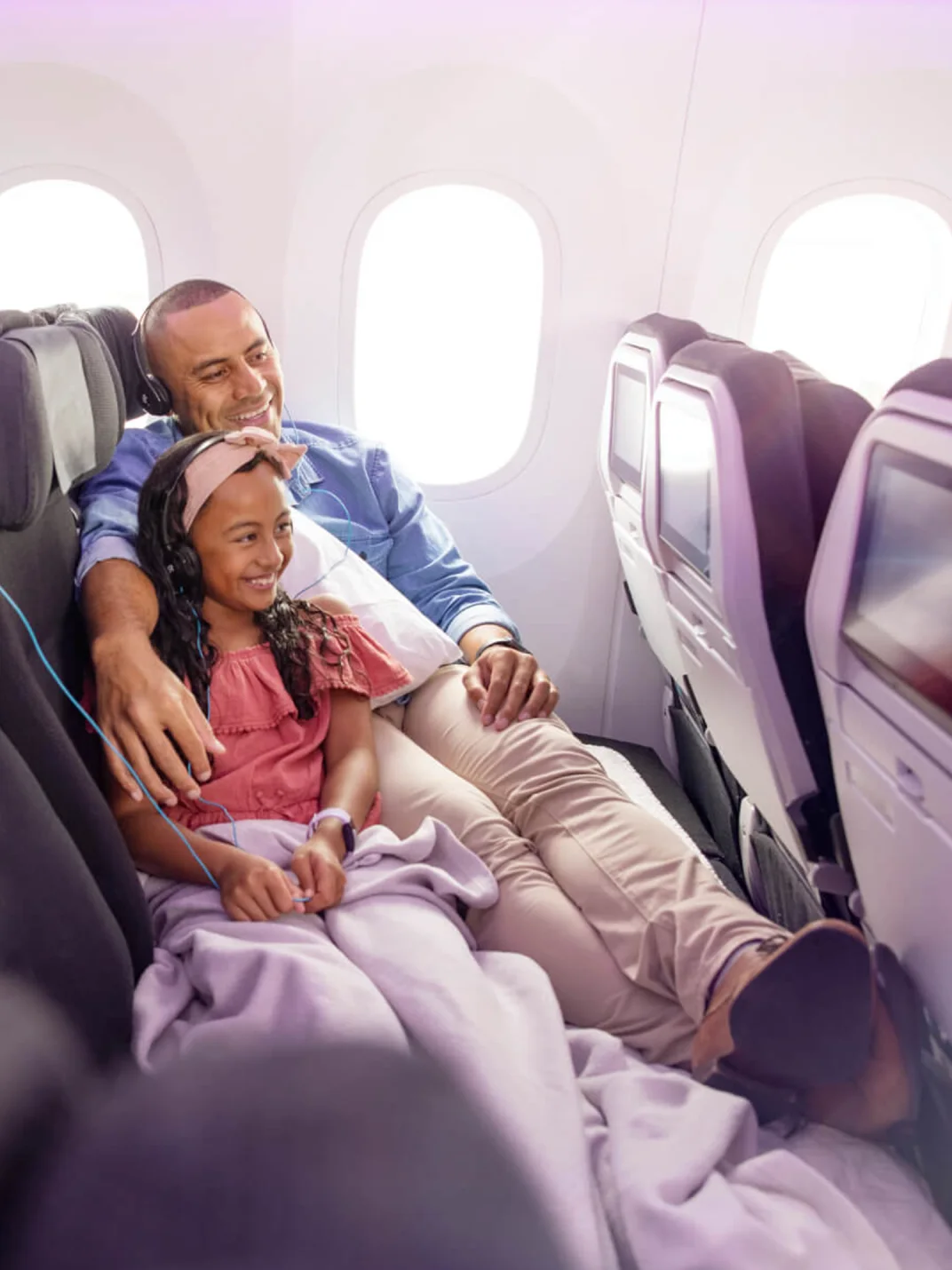
A parent travelling with a small child can gain flexibility: the child has somewhere to curl up while the parent stays close. The photograph helps explain that advantage more clearly than the word “flat”. It also shows why the size of the people using it matters.
For two adults, the decision is more demanding. The 74cm depth belongs to the shared couch; it is not 74cm for each person. Two people who like different sleeping positions, need frequent access to the aisle or dislike close contact may prefer two Premium Economy seats even if the couch looks more appealing in isolation.
A solo traveller has the full row surface but may face a larger supplement than a group already buying multiple Economy fares. Comfort and price therefore move in different directions: having the couch to yourself can make it more useful, while also making the upgrade harder to justify.
03A row supplement and a per-person upgrade need the same denominator

Read the diagram as text
- Economy + Skycouch
- 2 × $900 + $900 = $2,700
- Premium Economy
- 2 × $1,500 = $3,000
- Group difference
- $300 for two people
| Option | Calculation | Group total |
|---|---|---|
| Economy | 2 × $900 | $1,800 |
| Economy plus one Skycouch | 2 × $900 + $900 row supplement | $2,700 |
| Premium Economy | 2 × $1,500 | $3,000 |
In this example, Premium Economy costs $300 more for the group, not $600 or $900 more. The question is whether two individual larger seats and the associated service are worth $150 each compared with sharing the couch. Comparing the $900 row supplement with one person’s $600 Premium Economy uplift would give the wrong answer.
For a solo traveller, the equation changes again. Use the actual Skycouch price offered for one passenger; do not assume the row supplement from a two-person quote carries across. The airline prices the option according to factors including the booking and number of travellers.
Travellers booking from Canada should make the same comparison in Canadian dollars using Canadian-market quotes. A US fare example is not a Canadian price, and neither establishes the points or upgrade options available on your ticket. With return trips, add up the supplement separately in each direction.
04Premium Economy now needs a seat-generation check
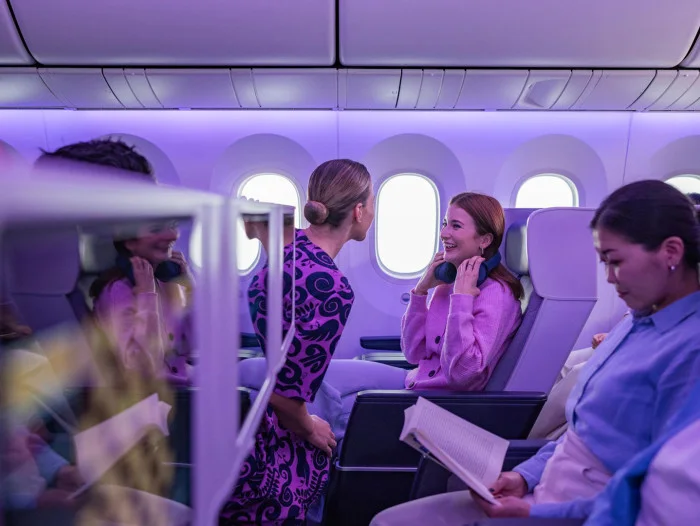
Air New Zealand’s current product page distinguishes newer 787-9 Premium Economy seating from older versions. The newer shell-style design and published 41-inch pitch should not be assumed to describe every aircraft carrying the Premium Economy label.
This matters when using reviews. The Alviator’s March 2026 Auckland–Hong Kong report and Forward of the Wing’s Auckland–Bali account show older 787 seating. They are useful for storage, service and that particular seat, but they are not evidence of the newest cabin. The aircraft version and the pictures must agree.
A newer Premium Economy seat may change the balance for a traveller who values personal space while reclined. It does not change the basic distinction: Skycouch creates a shared surface inside Economy; Premium Economy gives each person a different seat and service package.
05What to look for in a firsthand account
The most useful details are the writer’s height, the number of people sharing the row and the sleeping position they actually used. Paul Wallbank’s historical Skycouch account describes a six-foot-tall traveller bending his legs, rather than a full-length Business bed. The age of that report is relevant to the soft product, so current service expectations should come from today’s airline information.
For Premium Economy, photographs of the seat ahead in a reclined position are more informative than an empty cabin before boarding. Add the seat generation and the length of the flight, and the review becomes a practical comparison instead of a simple “worth it” verdict.
Paul Wallbank: a tall solo traveller’s Skycouch experience (2015)
Related flight reviews
Air New ZealandAuckland Hong Kong
Boeing 787-9 · Premium economy
Review: Air New Zealand 787 Premium Economy (AKL-HKG)
The AlviatorRead review Air New Zealand
San Francisco Auckland
Boeing 777-300ER · Economy
Travel review – Air New Zealand Economy Skycouch
Paul WallbankRead review Air New Zealand
Auckland Bali
Boeing 787-9 · Premium economy